


Q & D Technology, Inc.

“Standish also found that 31% of US IT projects were canceled outright and the performance of 53% ‘was so worrying that they were challenged.’ (Faeth, 2022).”
Strategic IT Initiatives require Strategic IT PMO Leadership Professionals
To Provide Wrap-Around Support for your PMO and Manage Your PMs

Statistics continue to quantify that a majority of U.S. IT projects fail, are cancelled, underperform, or complete over budget, often with missed dates or entirely missed commitments. Decades of research show that roughly 70% of IT projects do not deliver their intended value, with nearly a third cancelled outright and the remainder routinely finishing late, over budget, or below expected functionality. Large projects fare even worse, running almost 50% over budget, delivering half the expected value, and consuming billions in wasted investment annually. These outcomes are not anomalies; they are systemic patterns driven by chronic issues in requirements clarity, stakeholder engagement, governance discipline, and delivery readiness.

How Senior Program Manager Oversight and Governance Improves IT Project Outcomes
Placing a Senior Program Manager in a program‑level oversight role directly improves these failure statistics by introducing the level of governance, coordination, and risk control that most IT projects lack. The Senior Program Manager provides strategic supervision across multiple projects, ensuring that requirements are clear, dependencies are managed, risks are escalated early, and teams remain aligned to business objectives. Their oversight stabilizes delivery, reduces schedule slippage, and enforces disciplined execution across PM teams. By maintaining operational readiness, strengthening communication channels, and shaping delivery standards, the Senior Program Manager closes the gaps that historically lead to cancellations, overruns, and missed commitments. In short, their presence transforms fragmented project activity into a unified campaign, significantly increasing the likelihood that programs deliver on time, on budget, and with the intended business value.

Even if launching a full PMO is outside of your current financial margins, strategically aligning Senior Program Managers across domains, project clusters, programs, workstreams, SOWs, and other delivery swimlanes creates an immediate stabilizing effect on execution. Senior Program Managers function as force multipliers: they impose governance discipline, unify fragmented delivery efforts, and ensure that cross‑team dependencies, risks, and requirements are managed at the right altitude. Their oversight reduces schedule slippage, strengthens stakeholder alignment, and increases the likelihood that projects deliver on time, on budget, and with the intended business value. In lean environments, a single Senior Program Manager can serve as a de facto PMO nucleus, providing the strategic coordination, escalation authority, and operational rigor that materially improves project outcomes long before a formal PMO is established.
A Program ≠ A Project
IT Domain managers and business units often prioritizes project execution, but PMO leadership and program management is still widely misunderstood and frequently undervalued. Many organizations treat it as nothing more than “a bigger project,” missing its true purpose as a strategic discipline. In reality, program management provides the cross‑initiative coordination, dependency management, governance structure, and strategic alignment that prevent the very failures that plague IT delivery. When program management is neglected, organizations lose the oversight altitude required to manage complexity, anticipate risks, and ensure that multiple projects move in formation toward enterprise outcomes. When it is embraced, program management becomes the backbone of delivery stability, dramatically improving execution quality, predictability, and value realization.

Program Owners vs. Project Managers
Differences in Roles, Skillsets, Functions, & Responsibilities
Program management is a strategic discipline that operates above project management, providing senior leaders with a clear, structured framework for defining organizational change, articulating expected benefits, prioritizing initiatives, and understanding how multiple projects interact to deliver enterprise outcomes. It establishes the governance, alignment, and oversight needed to ensure that complex change is coordinated rather than fragmented, enabling organizations to manage dependencies, anticipate impacts, and execute transformation with greater predictability and value.
Often, recruiters criticize candidates, stating that a Sr. Program Manager is “STUCK” on a title, when they explain that they are not a PM.
This is a common misconception.
When you need Strategic PMO Leadership, hiring a project manager is NOT the correct skillset.
A PMO Leadership Professional is NOT a PM.


However, both a Project Manager and a PMO Leadership Professional are:
Two Divergent, Formalized Roles, Responsibilities, & Competencies Equally Valuable to the PMO
Both roles strengthen an organization in different but complementary ways: an effective project manager ensures that projects are executed in alignment with the company’s objectives, while a program manager defines those objectives at the strategic level and orchestrates how multiple interconnected projects should work together to achieve them. Project managers drive tactical execution; program managers shape the mission, the priorities, and the coordinated path forward.
PMO Leaders & Project Managers
are NOT
Interchangeable
Two Totally Distinctive Skillsets, Mindsets, Approaches, & Disciplines
Program management is a strategic discipline that operates above project management, providing senior leaders with a clear, structured framework for defining organizational change, articulating expected benefits, prioritizing initiatives, and understanding how multiple projects interact to deliver enterprise outcomes. It establishes the governance, alignment, and oversight needed to ensure that complex change is coordinated rather than fragmented, enabling organizations to manage dependencies, anticipate impacts, and execute transformation with greater predictability and value.

PMO Leadership Professionals:
Project Mgmt. Professionals:
-
Mindset: Strategic, Multidisciplinary, Macro, Enterprise-level Thinker...Metrics, Data, Analysis, Context, & Framework Oriented
-
Role: Focuses on Oversight, Governance, Goal Realization, Performance Measurements, Change, Scope, Cost, & Conflict management, TSAs/SLAs, Regulatory, Compliance, Baselines, Quality, Strategic Requirements, Financial Safeguards, Principal Milestones, etc.
-
People Manager: Executive-facing leadership, people managers, with direct accountability for decisions
-
Manages & Mentors Project Managers & Evaluates PM Performance
-
Peer Advisor for Executives, Board of Directors, and multiple layers of stakeholders
-
Workloads: Manages Wide, Enterprise-Level Scope for Long-term Programs, multiple Workstreams, and/or numerous strategic roadmaps, corporate investments, or contractual Service/Solution deliveries
-
Approach: Actualizing Big Picture, Centralized, Long Term, Comprehensive Corporate Strategic Values, Goals, ROI, & Tangible Outcomes. Delivering Streamlined Business Benefits linked to the Corporate Visions & Missions while acting as proficient Gatekeepers
-
Aligned with V- & C-level Executives, Steering Committees, Board of Directors, and Stakeholders. Reporting to VP of PMO or CIO/CTO
-
Initial Engagement: While effort is in ideation stage, POC, Pilots, and/or pending funding to Stand-up programs & formulate segmented, phasal projects
-
End Game: A culmination of Success of Project Manager undertakings, Consolidated mobilization and maintenance of all moving program parts, and Strategic Realization of efficient & profitable overall program health, achievements, and outcomes
-
Emphasis on Thriving Inter-relationships: Interdependencies, Intra-dependencies, & interconnected project activities, mapping, & goals. Fully staffed, cross-functional, and collaborative program teams & inter-team coalitions
-
Standardizes Artifacts: Creates templates or document guidelines, Single Source of Truth Standards, Document Repository Systems, Document Archival Requirements, etc.
-
Formulates Tactics for Program & Project Delivery, Benchmark Criteria, Framework Specifications, Capacities Limitations, Metric Inputs, Cadence & Project Pacing, and Problem Identification.
-
Administers Risk Governance: Risk Avoidance Measures, Risk Identifications, Risk Breakdown Structures, Risk Mapping, Risk Controls, & Risk Mitigation, whether intersecting or in parallel paths of risk resolution to eliminate all barriers to success.
-
Mindset: Linear, Micro-level, Modular Tactical Thinker…Process, Timeline, Content, & Task-Oriented
-
Role: Focuses on compartmentalized schedules, deadlines, task completion, status reporting, secondary milestones, and daily operations for the delivery of project requirements within the specified timeline
-
Individual contributor: Front-line, tactical, independent worker, provides boots-on-the-ground perspectives, makes recommendations to decisions-makers
-
No direct reports, dotted-line reporting and informal evaluation of project team members
-
Peer Advisor for other PMs, Project Teams, and junior-level project support team
-
Workload: Manages 1 or more projects with limited scope, cost, timeline, and specified deliverables
-
Approach: Works Siloed Projects, often insulated from knowledge of the overall Executive Vision & prominent Corporate Ambitions
-
Aligned with Program Managers & Peer Stakeholders, Reporting to Program Managers and PMO Director or VP of PMO
-
Initial Engagement: After venture has been funded, approved, and segmented into projects, work packages, SOWs, and incremental, interconnected efforts by the Program Owner
-
End-Game: Completion of Deliverables Acceptable to Stakeholders
-
Emphasis on projects, project completion, and a purposeful, striving project team
-
Artifacts: Completes, Organizes, and Archives document outputs based upon PMO Guidelines, Recommendations, and Requirements
-
Executes project delivery Tactics outlined by PMO leadership
-
Compiles weekly updates on project achievements, sustained activities, risk mitigation progress, and raises concerns if additional circumstances arise that might evolve into risks or barriers to success.

Program Owners vs. Project Managers
Differences in Roles, Skillsets, Functions, & Responsibilities
Project managers are responsible for driving tactical execution and ensuring that deadlines, scope, and delivery commitments are met. Program managers operate at a higher strategic altitude, focusing on how each project contributes to the broader organizational mission. While project managers keep individual initiatives on track, program managers ensure those initiatives are coordinated, sequenced, and aligned to enterprise objectives, shaping the wider picture that projects collectively deliver.
Conventional PMO Hierarchy Framework
This diagram illustrates the conventional PMO hierarchy most organizations rely on today, a foundational, multi‑tiered reporting structure built around coordination, support, management, leadership, and delivery roles, with both horizontal and vertical governance flows. Its purpose is to show career paths, PMO talent pools, and baseline resource categories within supportive, directive, and controlling PMO models. These PMOs are typically staffed with highly experienced and credentialed leaders and individual‑contributor managers and specialists who anchor project, program, and portfolio delivery.
Conventional PMO Hierarchy Framework

This illustration highlights the wide spectrum of professional skillsets embedded within a PMO, from strategic leadership and program oversight to project execution, analysis, coordination, and support. It reflects how PMOs integrate multiple disciplines into a single operational ecosystem, combining oversight, analytical, managerial, and governance capabilities to strengthen delivery across the organization.


Senior Level IT, PMO, Change Mgmt., & Business Strategy Purple Squirrels
We Do NOT Staff PMs
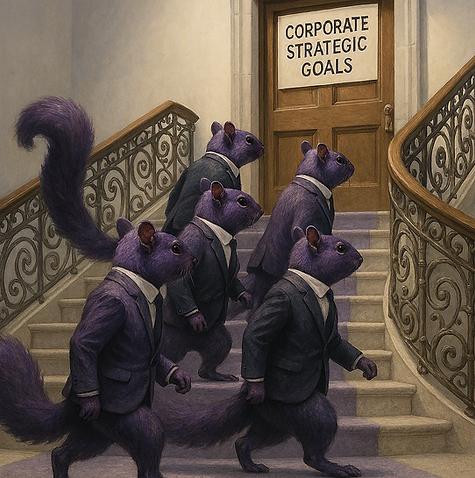
We Do NOT Staff PMs
Senior Level IT, PMO, Change Mgmt., & Business Strategy Purple Squirrels
Q&D Technology Consultants are ALL senior-level, executive-adjacent, or executive Leadership professionals, such as Business Directors, Infrastructure Directors, Technical Program Directors, IT Senior Program Managers, PMO Managers, OCM Consultants, etc.
Q & D Technology, Inc. brings Risk Adverse Strategy to your Technical Solution Delivery and comprehensive Technical PMO reinforcements to the Implementation, while filling all Gaps in your PSO (program support office).

Scholarly References Quoted in this Content
Fair Use Act Disclaimer: Some information contained on this website is for educational purposes.